Difference between revisions of "4 Summary of projects and submitted material"
(→Reading Gendered Words (workshop with Rosalie Schweiker)at Library Interventions Leeds College of Art, April 2017) |
(→Let's Mobilize: What is Feminist Pedagogy?, with Rose Borthwick (workshop) at Feminist Arts Education, Institute for Art and Art Theory, Intermedia / Artistic Media Practice and Theory, Cologne University, 2017) |
||
| Line 469: | Line 469: | ||
Context: Three decades ago, political scientist Carolyn M. Shrewsbury in her text "What is Feminist Pedagogy? "argued: "Feminist pedagogy begins with a vision what education might be like but frequently is not. "In the 1990s, bell hooks claimed: "Feminist Thinking in the Classroom Right Now "! So, what is the current state of feminist affairs in institutional teaching and learning environments? What characterizes the relation between student and teacher, academic discourse, and the spaces of its implementation, subjective experiences and social dynamics, artistic methods, and their historical references? | Context: Three decades ago, political scientist Carolyn M. Shrewsbury in her text "What is Feminist Pedagogy? "argued: "Feminist pedagogy begins with a vision what education might be like but frequently is not. "In the 1990s, bell hooks claimed: "Feminist Thinking in the Classroom Right Now "! So, what is the current state of feminist affairs in institutional teaching and learning environments? What characterizes the relation between student and teacher, academic discourse, and the spaces of its implementation, subjective experiences and social dynamics, artistic methods, and their historical references? | ||
| − | Rose Borthwick (HDK-Valand) and Eva Weinmayr (HDK-Valand) addressed these questions reflecting on their experiences of co-organizing the three-day international event "Let's Mobilize: What is Feminist Pedagogy?" at HDK-Valand Academy of Arts and Design, University of Gothenburg in 2016, followed by a practical workshop. Instant posters were collectively developed and distributed at selected locations across the corridors, staircases, walls, and doors of the University building.<br/> | + | Workshop: Rose Borthwick (HDK-Valand) and Eva Weinmayr (HDK-Valand) addressed these questions reflecting on their experiences of co-organizing the three-day international event "Let's Mobilize: What is Feminist Pedagogy?" at HDK-Valand Academy of Arts and Design, University of Gothenburg in 2016, followed by a practical workshop. Instant posters were collectively developed and distributed at selected locations across the corridors, staircases, walls, and doors of the University building.<br/> |
Convened by Mirjam Thoman, Labor für Kunst und Forschung, Cologne University<br/><br/> | Convened by Mirjam Thoman, Labor für Kunst und Forschung, Cologne University<br/><br/> | ||
→[http://www.laborfuerkunstundforschung.de/#workshops see webpage Institute for Art and Art Theory, Feminist Arts Education] | →[http://www.laborfuerkunstundforschung.de/#workshops see webpage Institute for Art and Art Theory, Feminist Arts Education] | ||
Revision as of 14:14, 10 September 2020
Contents
- 1 Intro
- 2 Projects overview
- 2.1 AND Publishing – with Rosalie Schweiker and multiple collaborators (2009 – ongoing)
- 2.2 Library of Inclusions and Omissions (2016–ongoing)
- 2.3 The Piracy Project – with Andrea Francke and multiple collaborators (2010–2015)
- 2.4 Let's Mobilize: What is Feminist Pedagogy? three-day mobilization and workbook – with feminist pedagogy working group, Valand Academy, University of Gothenburg (2015–2016)
- 2.5 Boxing and Unboxing, Research Residency, MarabouParken Konsthall, Stockholm – with Rosalie Schweiker (April – August 2018)
- 3 Published (Fixed)
- 3.1 Against Immunization: Boxing as a Technique for Commoning (exhibition, score)at Open Scores - How to Program the Commons, Panke Gallery Berlin, September 21 – October 12, 2019
- 3.2 Micropolitics of Publishing (video interview), 15 September 2018
- 3.3 Confronting Authorship, Constructing Practices – How copyright destroys collective practice (book chapter)
- 3.4 More Verb, Less Noun - Publishing as Collective Practice (printed interview)
- 3.5 One publishes to find comrades (book chapter)
- 3.6 UND statt ODER – die Anatomie von UND (interview)
- 3.7 Rethinking where the thinking happens (public interview)
- 3.8 Radical publishing practice requires radical librarianship (twitter thread)
- 3.9 Dear Hannah (pamphlet)
- 3.10 Library Underground – a reading list for a coming community (book chapter)
- 3.11 Library Underground – welcome to my tent (performative reading/video)
- 3.12 We don't want this to become an exhibit (book chapter)
- 3.13 Borrowing, Poaching, Plagiarising, Pirating, Stealing, Gleaning, Referencing, Leaking, Copying, Imitating, Adapting, Faking, Paraphrasing, Quoting, Reproducing, Using, Counterfeiting, Repeating, Cloning, Translating, co-edited with Andrea Francke (book)
- 3.14 The Impermanent Book, co-authored with Andrea Francke (essay)
- 3.15 Outside the Page, Making Social Realities With Books (chapter)
- 3.16 "Let's Mobilize" Revisited (draft chapter)
- 3.17 Help! David Cameron Likes my Art (book chapter)
- 4 Discursive – teaching, workshops, presentations, discussions, think-ins (Unfixed)
- 4.1 Radical Publishing Practices Demand Radical Librarianship: Perspectives and Framing Under the Disguise of Neutrality (presentation), at We Publish, Kunsthalle Bern, 16-17 January 2020
- 4.2 Moments of Autonomy. Feminist educational practices for the digital commons (think-in) at Open Scores - How to program the Commons, convened by Creating Commons, Panke Gallery, Berlin, 12 October 2019
- 4.3 Situated Collective Authorship (propositive input)at Authors of The Future: Re-imagining Copyleft Studyday, Constant, Brussels hosted by ISELP (Institut Supérieur pour l’Étude du Langage Plastique) Brussels, 27 September 2019
- 4.4 Library Talks, Rietveld Academy Amsterdam, 24 September 2019
- 4.5 Interfacing the Law (workshop) Constant Brussels & XPUB, Piet Zwart Institute Rotterdam, Infrastructural Manœuvres, Rietveld Library (Amsterdam) 9-10 May 2019
- 4.6 Experimental Publishing #1, Critique, Intervention, Speculation (symposium) at Centre for Postdigital Cultures, Postoffice, Coventry University, 11 April 2019
- 4.7 Tools and Infrastructures, Creating Commons (research meeting) at HeK, House of Electronic Arts, Basel 13.-16. September 2018
- 4.8 Writer X, with Eleanor Vonne Brown (workshop) at X Publishing School, Whitechapel Art Gallery London, 8 Sept 2018
- 4.9 Let's Mobilize: What is Feminist Pedagogy?, with Rose Borthwick (workshop) at Feminist Arts Education, Institute for Art and Art Theory, Intermedia / Artistic Media Practice and Theory, Cologne University, 2017
- 4.10 Reading Gendered Words (workshop with Rosalie Schweiker)at Library Interventions Leeds College of Art, April 2017
- 4.11 Library Underground (performative reading) at Miss Read , Akademie der Künste Berlin, 2016
- 4.12 Exploiting Justice, Symposium, Centre for Interdisciplinary Gender Research, University of Gothenburg, 2016 (presentation)
- 4.13 What is an Artschool, Chelsea College of Art, London, 2016 (presentation)
Intro
I have mapped a range of practices, concepts, and interventions that form a broad context for this practice-based inquiry in the chapter 03*Survey of the field. This chapter now gives an overview of the long-term collaborative projects I have carried out ("02*Projects"), the pamphlets, essays, articles I have (co-)published ("03*Published, Fixed") and the event-based activities, such as teaching, workshops, presentations, discussions, think-ins (04*"Discursive, Unfixed").
This inquiry consists of a string of related practical experiments I performed during my artistic career between 1998 and 2020. The projects attempt to rethink acts of publication, distribution, and consumption. They articulate enclosures, exclusions, and oppressions originated by dominant power structures. And they experiment with developing different models that facilitate an emancipatory, intersectional feminist, and to some extent de-colonial knowledge formation. As such, they can be described as counter-political projects that are held against dominant approaches to the topic.
One characteristic of these experiments is that most of them are collaborations. They often developed as responses to specific problems. These greatly differing instances cannot be understood within a conventional publishing framework. Instead, they fall into the expanded category of knowledge practices.
A pivotal common approach of these experiments is that they don't intend to make works "about politics". Instead, they aim at finding operational models to work counter-politically – through the actual practice itself. Hence my artistic concern is not to illustrate a political position, but to actively engage in political experiments in publishing and ecologies of knowledge.
The projects discussed below fall in a wide range of contexts. What they have in common though is that they can all be seen in relation to institutions – with some being commissioned by institutions, others being situated in institutions (with and without an official mandate), and yet a third group operates "exstitutional", a term coined by Constant, Brussels, indicating a transversal collective working environment that is often inoperable within mainstream institutions. Lastly, most of these experiments are projected long-term. They develop over time to test out various agile approaches. If one approach is not working, it is adapted and applied again from a different angle. That is the reason why the following list is so comprehensive.
Projects overview
In the following, I give a brief summary over the five practice projects, each described in more detail on the individual project pages summarized below.
AND Publishing – with Rosalie Schweiker and multiple collaborators
(2009 – ongoing)
⟶ see project 1: AND Publishing

AND is a collaborative publishing activity based in London. Initiated in 2009, it seeks to develop infrastructures of publishing starting from three questions: Why publish, how, and for whom? Observing that the existing institutional infrastructures keep replicating the exclusionary mechanisms and hierarchies dominating the university, AND started, without a mandate, at Byam Shaw School of Art in North London as an indy-university press, publishing works of students, staff, and alumni in an equitable and non-hierarchical manner. Next to exploring the immediacy and social possibilities of print on demand and new modes of distribution, AND also explores the social agency of cultural piracy. AND is also invested in radical and feminist pedagogy, builds informal support structures by sharing a studio, providing resources and advice, as well as access to skills, means of production and distribution. AND re-distributes budgets, commissions work, and (re-)publishes material, which is difficult to find. AND was co-founded by Lynn Harris and Eva Weinmayr. Andrea Francke worked temporarily with AND and Rosalie Schweiker joined in 2015. AND's 10-year long practice forms the basis and context for the artistic projects submitted for this PhD.
Library of Inclusions and Omissions
(2016–ongoing)
⟶ see project 2: Library of Inclusions and Omissions

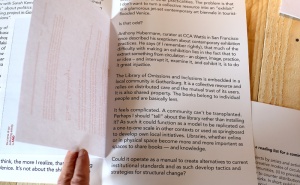
The Library of Inclusions and Omissions (LIO) is a practice-based experiment in critical knowledge infrastructures. Through an open call for contribution, it sets up a reference library that is curated by the community using it. So far, roughly 100 contributions are on the shelf. The collection is available to the public via temporary reading rooms. The library gathers feminist, intersectional, postcolonial materials which are not, or only sparsely available in institutional collections or databases, too flimsy in format or otherwise not validated by publishing houses or institutions such as libraries. Can such a curatorial concept help to give voice to undiscovered, suppressed, or otherwise not acknowledged material? Can this turn a library from a repository of knowledge into a space of social and intellectual encounters? The project's framework is initiated by Eva Weinmayr and developed through inputs by many contributors.
The Piracy Project – with Andrea Francke and multiple collaborators
(2010–2015)
⟶ see project 3*The Piracy Project

The Piracy Project started in collaboration with artist Andrea Francke as a reaction to the imminent closure of Byam Shaw School of Art Library in London. Through an open call for pirated books to populate the self-governed art school library and through researching pirate book markets in Peru, China, and Turkey, The Piracy Project gathered a collection of around 150 copied, emulated, appropriated and modified books from across the world. Their copying approaches vary widely, from playful strategies of reproduction, modification, and reinterpretation of existing works to circumventing enclosures such as censorship or market monopolies, to acts of piracy generated by commercial interests. This collection of books serves as the starting point to explore the common understanding of authorship, originality, and the implications policy and legal developments have had on intellectual property and copyright. Through temporary reading rooms, workshops, lectures, discussions, and debates, The Piracy Project explores the philosophical, legal, and social implications of cultural piracy and creative modes of dissemination.
The project is a collaboration with artist Andrea Francke and flourished through book contributions and critically of a wide range of contributors.
Let's Mobilize: What is Feminist Pedagogy? three-day mobilization and workbook – with feminist pedagogy working group, Valand Academy, University of Gothenburg
(2015–2016)
⟶ see project 4*Let's Mobilize: What is Feminist Pedagogy?

'Let's Mobilize: What is Feminist Pedagogy?' is a collective investigation into intersectional feminist and queer pedagogies, that led to the organization of a three-day international mobilization at HDK-Valand, University of Gothenburg, in October 2016. The workgroup formed by the desire to articulate and create a space for a queer and feminist perspective on learning and teaching inside and outside of the art academy. The feminist pedagogies workgroup consisted of students, staff, and administrators at the art academy. Its aim was twofold: Firstly, to provide a space to discuss the highs and lows in our own learning and teaching. To study and review university policies and institutional habits. To jointly read relevant texts and set up an online shadow library on feminist intersectional de-colonial pedagogies. This happened in bi-weekly lunchtime meetings that were open to the whole academy.
In a second step, the group worked towards organizing an international conference (mobilization) that fundamentally rethinks how knowledge is produced, transmitted, and disseminated. We were keen to find strategies to adjust the Euro-centric canon and its exclusions, to question institutional habits and procedures, and to create an understanding of equality that is not blind to difference. The mobilization itself was a practice-based investigation experimenting with non-normative use of the classroom, time and temporalities, languages, and paying attention to the empirical body. The core workgroup consisted of Kanchan Burathoki, Rose Borthwick, Gabo Camnitzer (2015), MC Coble, Andreas Engman, Eva Weinmayr.
Boxing and Unboxing, Research Residency, MarabouParken Konsthall, Stockholm – with Rosalie Schweiker
(April – August 2018)
⟶ see project 5: Boxing and Unboxing

Boxing and Unboxing is a collaborative project to learn how to "box" and "unbox" taking place in the context of AND Publishing's six-month research residency at Marabouparken Konsthall in Stockholm in 2018. It started with a set of questions: Where do we put the many things we are doing that don't fit into boxes? What is the problem with categorization? Why do we not want a unified face? How can we subvert the social pressure to produce faces? Why would we go on a residency when we struggle to pay rent at home? Where can we store our boxes? Who gives in? Who compromises? Who accommodates? Who cares? Do we need a new, less tired, and exclusive language to talk about all this? And how do you document laughter?
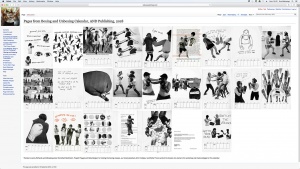
Together with curator Jenny Richards, AND organized a two-week boxing training for self-defining women that were free and open for all abilities, ages (16+), shapes and religions. We were curious to learn about non-verbal negotiation, care, anger, dialogue, transgression, and defense. It was an experiment to explore whether sparring, when defined as physical play and not geared towards victory or defeat, could help to rehearse ways to relate to each other in other areas. If we understood sparring on the mat as a moment of intense negotiation of border space, contagion, and border linking (Ettinger 2006) could this experience "unbox" the boundaries that we elsewhere seek to protect?
This project was developed by Rosalie Schweiker and Eva Weinmayr (AND Publishing) and curator Jenny Richards (MarabuParken Konsthall).
Published (Fixed)
Against Immunization: Boxing as a Technique for Commoning (exhibition, score)
|

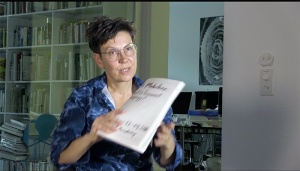
Micropolitics of Publishing (video interview), 15 September 2018In this podcast Cornelia Sollfrank talks with Eva Weinmayr about AND Publishings contingent and contextual publishing practice, about collectivity and tactics to escape regimes authorship and ownership, and the relationship between an expanded understanding of publishing and feminist pedagogy. The interview was conducted in the context of the research meeting "Tools and Infrastructures" at House of Electronic Arts (HeK), Basel, September 13–16, 2018 in the context of Creating Commons is a research project by Shusha Niederberger, Cornelia Sollfrank and Felix Stalder at the Institute for Contemporary Art Research, Zürich University of the Arts, (2017 – 2020). |
Confronting Authorship, Constructing Practices – How copyright destroys collective practice (book chapter)This chapter investigates the coercive relationship between authorship and copyright from the perspective of intersectional feminist knowledge practices. Examining three artistic strategies (Richard Prince, Cady Noland, The Piracy Project) that all try to challenge the close ties between copyright and authorship – although with very different outcomes – I map the blockages and contradictions that an understanding of authorship grounded in possessive individualism creates for critical art, education, and collective knowledge practices. Trying to politicize individual authorship I investigate its construction by legal, economic, and institutional frameworks and subsequently ask how this chapter would circulate in current systems of dissemination, validation, and authorization if I did not assign my name to it - if it went un-authored so to speak.
In " Whose Book is it Anyway? A View from Elsewhere on Publishing, Copyright and Creativity", edited by Janis Jefferies and Sarah Kember, Cambridge: Open Book Publishers, 2019 |

More Verb, Less Noun - Publishing as Collective Practice (printed interview)In this interview, Eva Weinmayr and Jinglun Zhu discuss modes of production and dissemination of underground publications, the politics of authorship and reproduction, and publishing in relation to collaborative knowledge practices. The conversation also offers insights on modes of collectivity in higher education and methods for archiving ephemeral materials. in CCS Recollection 1: The Netletter, edited by Evan Calder Williams, Centre for Curatorial Studies CCS Bard, Annandale/New York, 2019 |
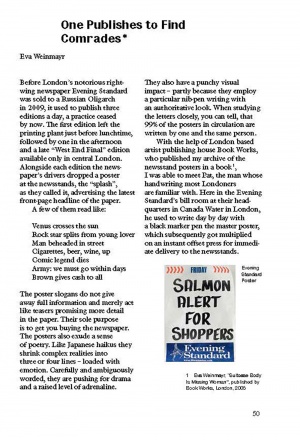
One publishes to find comrades (book chapter)This book chapter examines how collective techniques of publishing can initiate a social process where printed publications, posters or zines are not necessarily an end product trying to convince someone of something, but rather as a method for "working towards establishing conditions for the co-production of meaning." (Shukaitis, 2014)Originally published in The Visual Event, an education in appearances, edited by Oliver Klimpel, Leipzig, Spector Books, 2014. |
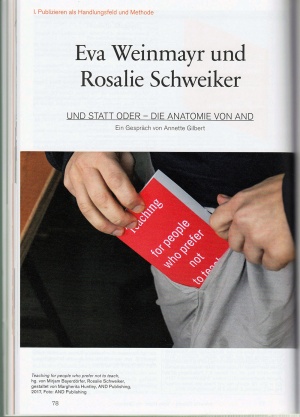
UND statt ODER – die Anatomie von UND (interview)In this interview, Annette Gilbert, Rosalie Schweiker and Eva Weinmayr discuss the multiple roles AND publishing takes on (artist, researcher, educator, curator, collector, librarian, host, organizer, and activist) and reflect on the dilemmas, contradictions and joy such a contextual, contingent, informal, supportive and precarious practice involves.
The interview is published in an anthology about contemporary artists' publishing.
|
Rethinking where the thinking happens (public interview)In this public conversation that has been recorded and transcribed, Eva Weinmayr asks Sarah Kember, co-founder and director of Goldsmiths Press, London about her plans to set up a new experimental academic press at Goldsmiths, and the problems and opportunities of open access publishing. This conversation took place on July 8, 2015 at Chelsea College of Art and Design during Study Day – Why Publish?, the University Gallery and Archives, a joint research by Joyce Cronin (Afterall), Karen Di Franco (Chelsea Space) and Eva Weinmayr (AND Publishing). Funded by Curriculum Development, Student Enterprise and Employability (SEE), University of the Arts, London. Published by AND Publishing, London, 2015, republished in Let's Mobilize: What is Feminist Pedagogy?, edited by Feminist Pedagogy Workgroup (Kanchan Burathoki, Rose Borthwick, MC Coble, Andreas Engman, Gabo Camnitzer, Eva Weinmayr), HDK-Valand, Gothenburg, 2016. |
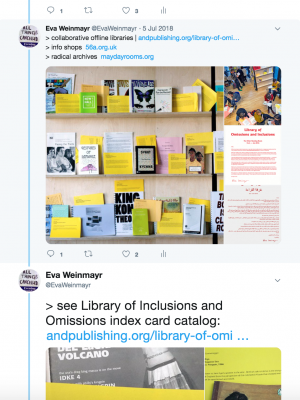
Radical publishing practice requires radical librarianship (twitter thread)This publication was published live via a twitter thread during my presentation at the symposium "Artists as Publishers as Artists". Experimenting with citational practice and the act of sharing bibliographies the thread to published the references used, (vids, images and texts) for the audience to revisit. Part of the panel "Publishing to Mobilize Knowledge" this presentation discusses the relationship between practices of production, circulation, and consumption of radical, critical, artistic publishing. What are the institutional infrastructures and routines (libraries, archives, bookstores, etc.) of naming and framing, of selecting and cataloging, and how do these routines privilege, or exclude knowledges that don't fit into the established categories?
|
Dear Hannah (pamphlet)Written in epistolary form, this short text, shares concerns related to my participation at the 57th Venice Biennale. It reflects on issues of co-option, on collective and community-based work, on artistic ambition, and the limits of what is exhibitable in the context of an international art biennale. The text has been circulated as an email letter and printed pamphlet.
|
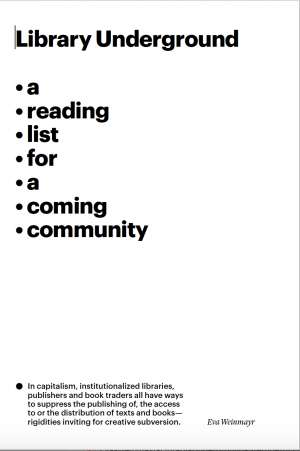
Library Underground – a reading list for a coming community (book chapter)Written in the form of an informal conversation between Eva Weinmayr and her inner voice, this book chapter discusses practices of radical librarianship and underground dissemination. It touches on a set of examples reaching from the informal distribution strategies of the Whole Earth Catalog to the radical librarian movement in California in the 70s (Celeste West, Sanford Berman) to contemporary shadow librarianship (aaaaarg, Memory of the World, The Piracy Project). Concerns and questions about the original scope of public libraries to provide access to knowledge "for every member of the community" (ALA, Library Bill of Rights 1939) seem to crop up throughout the conversation: Who is a library for? What kind of materials and topics are missing and how can we deal with the implicit biases in the organization and classification of knowledge?
|
Library Underground – welcome to my tent (performative reading/video)This video presents a filmed performance lecture pf the above book chapter, that revised and updated has been performed from inside a trekking tent installed at HDK-Valand's main lecture hall. The audience listened to the voices speaking inside the tent and watching a video transmission of the happenings inside that was projected onto the lecture hall screen. With Eva Weinmayr as Eva Weinmayr and Rose Borthwick as Inner Voice. Filmed and edited by Camilla Topuntoli. Video 32 min. At the symposium "Photography in Print and Circulation," convened by Louise Wolthers (Hasselblad Foundation), Niclas Östlind, (HDK-Valand) /HDK-Valand, 2016.
|

We don't want this to become an exhibit (book chapter)Based on a presentation manuscript this chapter reflects on the ways the Piracy Project reading rooms can operate as a starting point for critical reflection (workshops), discourse (discussions) and policy debate. It reflects on the possibilities and limitations of (i) the project as exhibition, (ii) the project as a discursive device, (iii) the project situated in a community of practice. The workshop brought together practitioners and theoreticians with the aim to share strategies and experiences how to turn an archive from being a repository into a space of social, intellectual, and political encounter. Workshop "Socialising Archives" during symposium "Archives of the Commons II – The Anomic Archive", Museo Nacional Reina Sofia in Madrid, 2018, chaired by Mabel Tapia. In the book Archivos del Común II: El Archivo Anómico, (Spanish) edited by Fernanda Carvajal, Mela Dávila Freire, Mabel Tapia, designed by Lucía Bianchi and Ramiro Alvarez, published by Red Conceptualismos del Sur, 2019. |
Borrowing, Poaching, Plagiarising, Pirating, Stealing, Gleaning, Referencing, Leaking, Copying, Imitating, Adapting, Faking, Paraphrasing, Quoting, Reproducing, Using, Counterfeiting, Repeating, Cloning, Translating, co-edited with Andrea Francke (book)The title of this publication is a long list of terms that are broadly concerned with piracy, in such that they reflect different relationships to somebody else's work. The terms will be explored in chapters from different fields of knowledge. The first version (2014) includes a range of essays while other terms/chapters are still to be explored and written. As such the book is an ongoing and open-ended reader, which develops over time. "This book is not finished. It is the start of a dialogue that will grow as we go along. Normally when you publish a book, it aims to be a resolved object, an endpoint of a process. Not this one. The thing is that there are two of us, and that has become one of the key determinants of how the project evolves. There are always two voices, and that allows us always to be open to different positions. I guess that's what I call a dialogue." (Excerpt from the introduction to the book). The aim of this specific model of editorial work was to use publication not as an endpoint of a process, but to initiate or feed into a discourse that in turn feeds back into the book. This dialogical slow-grow approach was supported by the funding model. People bought shares in one of the terms that they wished to be explored in form of a future essay. So far, the book contains essays and contributions by Dave Hickey, Eva Hemmungs-Wirtén, Joanne McNeil, Karen Di Franco, Lionel Bently, Prodromos Tsiavos, Sergio Munoz Sarmiento and awaits prospective essays by James Bridle, Stephen Wright and 16 others. Courtroom drawings are by Stephanie Thandiwe Johnstone. |

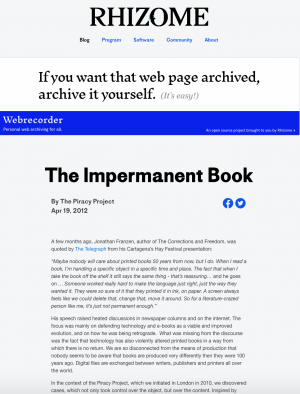
The Impermanent Book, co-authored with Andrea Francke (essay)The essay discusses the potential unease and unsettlement that the instability of digital print poses to the assumed authority of the mass-produced printed book. It argues that the prevailing understanding of a book as fixed and immutable object is partly due to the industrial printing press. The emergence of digital print and print-on-demand, however, arguably changes this perception, since due to small print runs digital print allows for continuous changes, adaptions, and revisions. The text discusses the effects of such versioning on the reader. What happens when books become unreliable objects? When one copy of a book potentially tells a different story than the other copy of the same title? In Rhizome.org, 2012 and in Best of Rhizome 2012, edited by Joanne McNeil, Brescia: LINK Editions, 2013 |
Outside the Page, Making Social Realities With Books (chapter)This chapter examines two publications that both in different ways engage with the temporality and situatedness of reading practice. Marcel Brodthaers' "Voyage on the North Sea" (1974), a two-part work consisting of a film and a book, creates interdependency between the temporality of the visual narrative in the book and the reader's actual temporality when flipping through the pages of the book. Let's "Mobilize: What is Feminist Pedagogy? Workbook", a contextual publishing experiment by the Feminist Pedagogy workgroup at HDK-Valand Academy for Art and Design (2016) turns the academy building into a walkable book in an attempt to "socialize" the book. In The Filmic Page, "On Curating" ZHdK Zürich, edited by Chiara Figone, Paolo Caffoni and students of Nuova Accademia di Belle Arti Milano (NABA), forthcoming issue |
"Let's Mobilize" Revisited (draft chapter)This annotation experiment was co-written by the Feminist Mobilization Working Group at HDK-Valand Academy of Art and Design in Gothenburg. It revisits one chapter ("Glossary") in "Let's Mobilize: What is Feminist Pedagogy? Workbook" that has been collectively written by the same authors, published two years earlier. The act of revisiting the original text allowed the group to reflect with hindsight on the three-day event and the process of working together. By using the method of layered commentary, we preserved each author's voice instead of streamlining the writing into one voice. Here the collective writing of a text becomes a place for dialogue and disagreements. It builds on experiments of nonlinear writing done by Arno Schmidt ('Zettel's Dream', 1970) and Pierre Bayle ('Historical and Critical Dictionary', 1737).
|

Help! David Cameron Likes my Art (book chapter)File:Distributed Open Editions, London 2018 .jpg The text narrates the course of events triggered by the UK Government Art Collection's acquisition of my artwork "Today's Question" and its subsequent loan to Samantha and David Cameron, then Prime Minister of the UK, for their private residence at Downing Street. In Distributed, edited by David Blamey and Brad Haylock, London: Open Editions, 2018 |
Discursive – teaching, workshops, presentations, discussions, think-ins (Unfixed)
Radical Publishing Practices Demand Radical Librarianship: Perspectives and Framing Under the Disguise of Neutrality (presentation),
|
Moments of Autonomy. Feminist educational practices for the digital commons (think-in)
|
Situated Collective Authorship (propositive input)
|
Library Talks, Rietveld Academy Amsterdam, 24 September 2019Context: Gerrit Rietveld Academy, Sandberg Institute holds a monthly series of Library Talks where invited guest speakers introduce 10 books that have been important to their practice. These books will be acquired for the library collection. The idea behind this series is (i) to show the different voices that inform the guest speakers' practice and (ii) to practice a new form of library acquisition (iii) to introduce a different way to read the library collection. It can be explored through the library catalog and through the category "selection" that groups the 10 books together around the name of the guest speaker to trace their genealogy in the library collection. Presentation: I discussed ten selected books that each developed a specific approach to attribution and credit in the colophon that reflect the collective work that went into this publication. The list includes 1) Radical open Access - The Ethics of Care, Disruptive Media Lab, Postoffice Press, Coventry University, 2018; Uncounted by Emily Roysdon, Secession, Vienna, 2016; The Techno-Galactic Guide to Software Observation, Constant Brussels, 2018; I think that conversations are the best, biggest thing that Free Software has to offer its users, Constant Brussels, 2014; See Red Women’s Workshop: Feminist Posters 1974-1990 Four Corner Books, London 2016; The Feminist Bookstore Movement, Lesbian anti-racist and feminist accountability, by Kristen Hogan, Duke University Press, 2016; Let’s Mobilize: What is Feminist Pedagogy?, ed. Feminist Pedagogy Workgroup HDK-Valand, Gothenburg, 2016; Teaching for people who prefer not to teach, ed. Rosalie Schweiker and Mirjam Bayersdörfer, London: AND Publishing, 2017; Do the right thing, a manual from Malmö Free University for Women Johanna Gustavvson and Lisa Nyberg, Malmö, 2010; Synergy Magazine Index of years 1967-71 San Francisco: Bay Area Reference Center, 1972.
|
Interfacing the Law (workshop)
|
Experimental Publishing #1, Critique, Intervention, Speculation (symposium)
|
Tools and Infrastructures, Creating Commons (research meeting)
|
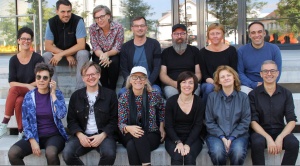
Writer X, with Eleanor Vonne Brown (workshop)
|
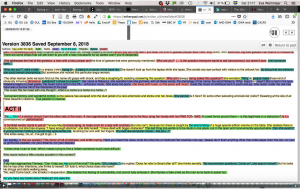
Let's Mobilize: What is Feminist Pedagogy?, with Rose Borthwick (workshop)
|

Reading Gendered Words (workshop with Rosalie Schweiker)
|

Library Underground (performative reading)
|
Exploiting Justice, Symposium, Centre for Interdisciplinary Gender Research, University of Gothenburg, 2016 (presentation) |
What is an Artschool, Chelsea College of Art, London, 2016 (presentation) |


