Project 3 * The Piracy Project
This isn't done yet
Contents
- 1 Starting point and context: Byam Shaw School of Art Library closure
- 2 Open Call for copied, modified, emulated, annotated books
- 3 Searchable Online Catalogue
- 4 Reading Rooms organised between 2010 – 2015
- 5 Organising Discursive Events
- 6 Talks, Interviews and Articles
- 7 Workshops, Collective Research, Teaching with the Piracy Project
- 8 Edited Publications
- 9 rest
Starting point and context: Byam Shaw School of Art Library closure

The Piracy Project started as a response to restrictive university policies, when in 2010, the university management announced to close the Byam Shaw School of Art library, due to a merger with the University of the Arts London. Students were advised to visit the library of the main campus in the city center. In a joint effort students and staff turned Byam Shaw’s art college library, supported by its acting principal, into a
self-organized and self-governed library that remained public, and intellectually and socially generative.
Open Call for copied, modified, emulated, annotated books
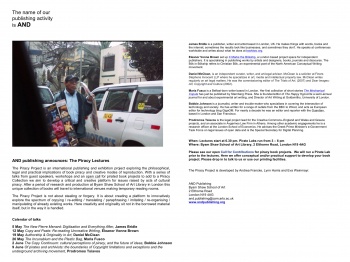
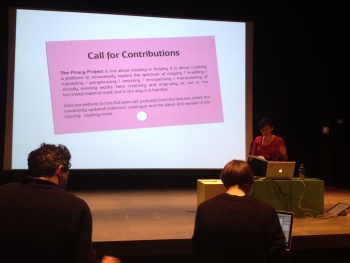
Andrea Francke & AND Publishing would like to invite you to contribute to The Piracy Project, an international publishing and exhibition project exploring the philosophical, legal and practical implications of book piracy and creative modes of reproduction.
With a series of talks from guest speakers, workshops and an open call for pirated book projects to add to a Piracy Collection we aim to develop a critical and creative platform for issues raised by acts of cultural piracy. After a period of research and production at Byam Shaw Reading Room in London this unique collection of books will travel to international venues in 2011.
The Piracy Project is not about stealing or forgery. It is about creating a platform to innovatively explore the spectrum of copying / re-editing / translating / paraphrasing / imitating / re-organising / manipulating of already existing works. Here creativity and originality sit not in the borrowed material itself, but in the way it is handled.
Searchable Online Catalogue

The local, national and international entries which we received – (i)from students, staff and alumni at the art school, (ii) sent to us from across the world or (iii) found through our research and residencies in Peru, China, Turkey – were catalogued on an online database. The catalogue descriptions, created in collaboration with John Moseley, provide selected metadata as well as the strategies of reproduction, modification and distribution used by the respective pirate. The catalogue lists: title, author(= pirate), date, publisher (= pirate), format, printing, and source (the book that had been copied).
See searchable online catalogue
Reading Rooms organised between 2010 – 2015
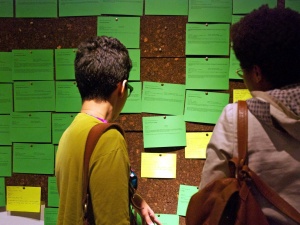
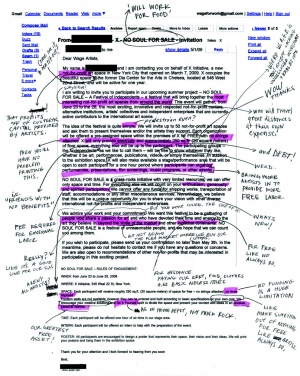
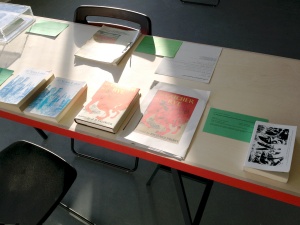
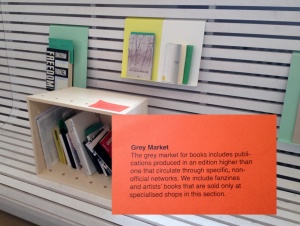
- File:Piracy Project Academy for Media Arts Cologne lr.jpgPiracy Project Reading Room, Glasmoog – KHM Academy of Media Art, Cologne. Curated by Heike Ander. 11 Sept – 25 Oct 2014



Organising Discursive Events
Showroom: Eva Hemmungs Wirten, The classroom New york art book fair 2013?
-
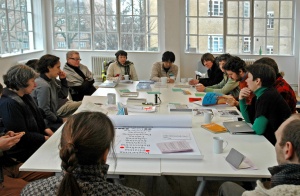 Roundtable with Eva Hemmungs-Wirten: Polyglot Piracy: Translation and the Instability of Texts
The Showroom London, 23 March 2013. https://www.theshowroom.org/events/and-publishing-residency -
 Performative Debate: A Day at the Courtroom, The Showroom London, 15 June 2013
With Lionel Bently (Professor of Intellectual Property at the University Cambridge), Sergio Muñoz Sarmiento (Art and Law, New York), Prodromos Tsiavos (Creative Commons, England, Wales and Greece). Courtroom drawing by Thandiwe Stephanie Johnstone . -
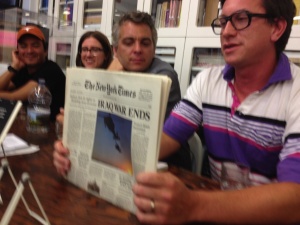 Panel discussion: Printed Matter, New York, 17 August 2012
With David Senior (bibliographer at MoMA), Anthony Huberman, (director of CCA Wattis Los Angeles), Joanne Mc Neil, (editor of Rhizome, NY), Sergio Munoz Sarmiento, (Art and Law, NY) in the exhibition Helpless curated by Chris Habib (July 14 - September 29, 2012). -
 Public Talk: Active and Passive Love of Books. Presented by Grand Union
The Piracy Project in conversation with Cornelia Sollfrank, Birmingham Public Library, 7.12.2013
→ Watch podcast -
 Public Talk: Cultural Piracy, with Nick Thurston (information as material, Kenneth Goldsmith (Ubuweb), Whitechapel Art Gallery, 24 Sept 2011. Where does the creative act lie in the process of copying? Cultural piracy is pervading publishing worldwide, but what makes these new forms original and what issues are raised? →Listen on sound cloud
-
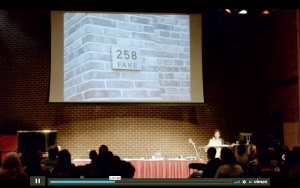 Public Talk: Andrea Francke at States and Markets @ Institutions by Artists convention. Organised by the Pacific Association of Artist Run Centres (PAARC), Fillip, and the ArtistRun Centres and Collectives Conference / La Conférence des collectifs et des centres d’artistes autogérés (ARCA).
Vancouver, 12 – 14 Oct 2012
→Watch session 6 States and Markets. -
 Conference Talk: Feminist Writing, Centre for Feminist Research, Goldsmiths College, London, Friday 6 June 2014 →Listen on itunes.
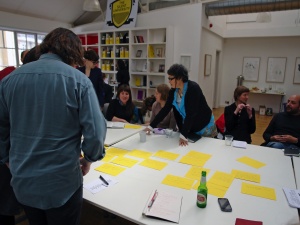
- The books in the Piracy Project Reading Room at Kunstverein Munich were organised according to their distribution strategies – differentiating whether they circulate in black markets, grey markets, white markets, print on demand or as archival distribution. (→ See more in "reflection"). In this spirit, these two-week workshop focussed on alternative and informal and counter-public archives, collections, libraries and bookshops as well as print shops in Munich. For this research into local and informal knowledge infrastructures we invited Ingrid Scherf, the co-founder of Munich's independent Basis bookshop and event space (closed in 2010) and co-editor of "Das Blatt", West Germany's first alternative city magazine, published between 1973-84 in order to give a voice to those who are not represented by mainstream media. Marcell Mars passed by from his residency at Akademie Schloss Solitude in Stuttgart to speak about his project Public Library, a collaboration with and Tomislav Medak. Sarah Käsmayr introduced us to her Raubkopiebuch investigating book piracy in the context of 1960s and 70s German student movement. Stephan Dillemuth invited us to unpack his Zine Archive. Ruth Höflich introduced us to her critical publishing practice and gave a guided tour through her father's print workshop, Druckwerkstatt Höflich, in Munich. Anna McCarthy invited us for a conversation about her exhibition Nein and her and Tagar's independent publishing, performance and recording practice. We also visited Steffi Hammann at the Munich Art Academy – where she together with Maria von Mier as a student set up a publishing house, Hammann von Mier, that operates from within the art school classroom. Finally we visited the copy shop Unikopie, a space – as the shop owners told us – is not only used as space for print production (making copies) but also for dissemination (leaving copies back in the shop for random people to pick them up). Download zine produced during the workshop
- File:Eva Weinmayr Confronting Authorship, Constructing Practices.pngForthcoming chapter 'Confronting Authorship, Constructing Practices', in Whose Book is it anyway - an anthology, Sarah Kember, Janis Jeffries (eds.), Cambridge, Open Book Publishers, 2019

Talks, Interviews and Articles
The seemingly indispensable tools we use daily for social networking and online communication are all increasingly provided to us for free. In fact, as our way of life is becoming dependent on these and other gifted resources, many of the largest and most influential companies in the world are beginning to profit more from giving certain things away than from charging for them. Perhaps this growing flood of gifted goods implies that one day, everything will be free. But in any case, it becomes increasingly obvious: we’re not paying for it because we’re not the customer, we’re the product being sold.
"Critical engagement with gift economies, open culture, intellectual property, and immaterial exploitation is not so new or unfamiliar, but the very real effects of these concepts are changing the way cultural practice is structured and how the once paying audience is now being enticed to remain involved, to keep giving, or to pay in other ways. But how are these new economic structures and their fundamental contradictions understood by cultural producers and social activists? How to engage with and situate oneself in relation to systems that facilitate the free exchange of information and ideas, yet simultaneously operate as structures of subjectification or mechanisms of corporatised social responsibility? Perhaps this could just start with a question a little closer to home: SALT is free, but at what or whose cost?
One day, everything will be free… is a long-term research project aimed at opening up questions about the economics of cultural institutional practice that in part stem from SALT being privately funded initiative partially located in the former Ottoman Bank. In order to encourage conversations about support structures for contemporary cultural production in Turkey, and to engage with cultural producers and audiences as they respond to and understand these structures, the dispersed research project will develop indefinitely with and through the participation of diverse publics and interlocutors. The invited speakers will look at the varied and conflicting legacies and implications of free economies, the recent turn within the field of cultural production toward reengaging with dormant economic imaginaries, and the changing relationships between what is privately owned and publicly shared in society." [1]
Copyright issues are in the media again - this time as part of a propaganda war. Witness Rupert Murdoch using Twitter to accuse Google of piracy, despite himself having been found guilty of heading an organisation involved in hacking. Some small victories in this war have been achieved: the service blackout coordinated by Wikipedia and others in January 2012 resulting in the Stop Online Piracy Act (SOPA) bill being postponed. Yet the real winner is Mr Big, in the guise of the multinational conglomerates of the cultural industries, who continue to control the production, distribution and marketing of the vast majority of the cinema, music, literature, television, art and design that constitutes our culture.
How, then, might we turn away from copyright laws designed for the benefit of the 1%, to find ways of openly sharing knowledge, culture and education, while at the same time providing creative workers with fair reward for their labour? Creative Commons licences, free and open source software, the movements for open access, open data and open education, free culture, peer-to-peer production, file and text-sharing networks along with other “pirate” strategies may all offer challenges to the current copyright system. Yet do we not need to establish some “chains of equivalence” between them, forms of mutual alignment between, say, open education, free software and even Occupy Wall Street and the student protest movements? Is the struggle for copyleft and copyfarleft only a cultural question? Or does it require the development of a new kind of economy and society: one based far less on possession, accumulation, competition, celebrity, and ideas of knowledge, culture and education as something to be owned, commodified, disseminated and exchanged primarily for the profit of individuals and corporations? [2]
Birmingham Library
Whitechapel art gallery
Why Write, Sarah Kember
Graz Truth is Concrete
SALT Istanbul
Leeds Nick Thustron
Institutions by artists, Vancouver
Side room amsterdam
Maria Guggenbichlers house
Workshops, Collective Research, Teaching with the Piracy Project
Kunstverein Munich
piet zwart rotterdam
RCA Collaboration?

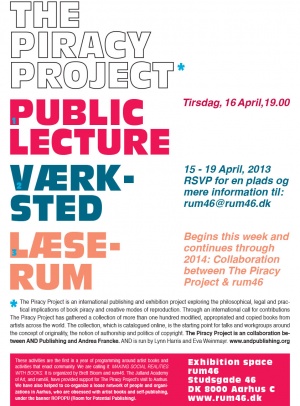
Brett Bloom (Temporary Services, Chicago) invited the Piracy Project to run a workshop in the series Making Social Realities with Books, which he co-organised with rum 46 in Copenhagen. The series of lectures and workshops explore the idea of how books – libraries, archives, publishing, and distribution - are used to create distinct social realities, whether it is in small communities, or entire movements within art practices and related activities. For this series Brett and rum 46 invited Art Leaks (New Brunswick), Eva Egerman (Vienna), Public Collectors (Chicago), David Senior (San Francisco), Banu Cenetoglu (Istanbul), Brandon LaBelle (Copenhagen), Delphine Bedel (Berlin) and Lauren van Haften-Schick (New York).
Participants of the Piracy Project workshop traveled from art academies in Denmark, Latvia and Estonia in order to collectively think through the complexities of cultural piracy. We explored strategies and ethics of unauthorised publishing, built on local facilities and knowledges, visited self-publishers, self-organised print shops, libraries and bookshops in Aarhus.


Edited Publications

The Piracy Papers is a series published in irregular intervals that explores material previously published online.
Piracy Papers#1 Jackson Hole by Michael Eddy & Grandpa Eddy, London: AND Publishing, 2012
Michael Eddy's Jackson Hole is an email exchange between Michael (based in Bejing) and his grandfather (based near Jackson Hole, USA) about the re-creation of the eponymous American town on the outskirts of Beijing, China and both writers's reflections on these two places that – although connected — are so different from each other.
Piracy Paper #2 The Author of Everything by James Bridle, London: AND Publishing, 2013
Piracy Paper #3 The Junk Ships on Alibaba by Joanne McNeil, London: AND Publishing, 2014

This book is not finished. It is the start of a dialogue that will grow as we go along. Normally when you publish a book it aims to be a resolved object, an end point of a process. Not this one. The thing is that there are two of us and that has become one of the key determinants on how the project evolves. There are always two voices and that allows us to always be open to different positions. I guess that’s what I call a dialogue.(Excerpt from the introduction to the book...)
The Piracy Project Reader is an open-ended reader, which will develop as people buy shares in one of its chapters. It explores the vocabulary relevant to Piracy Project and so far contains essays and contributions by Dave Hickey, Eva Hemmungs-Wirten, Joanne McNeil, Karen Di Franco, Lionel Bently, Prodromos Tsiavos, Sergio Munoz Sarmiento and awaits prospective essays by James Bridle, Stephen Wright and 16 others. Courtroom drawings are by Stephanie Thandiwe Johnstone. Many thanks to all supporters who have already bought a share.
rest


Published interview 'The Piracy Project' at 'Giving What you don’t have', 2013
Cornelia Sollfrank interviews Andrea Francke and Eva Weinmayr in the context of 'Giving What you don’t have', an artistic research project by Cornelia Sollfrank exploring the relationship between art and the commons at Postdigital Publishing Lab, Leuphana University, Lüneburg Watch the interview or read the transcript


