4 Summary of projects and submitted material
The just described activities and theorisations in the wider field of publishing and the formation of knowledge serve as a backdrop for a string of related practical experiments I carried out during my own artistic career between 1998 and 2018. They are practice examples where acts of publication, distribution and consumption have been rethought in order to firstly articulate enclosures, exclusions and oppressions originated by dominant power structures and secondly to experiment with and develop different models, that facilitate an emancipatory, intersectional, de-colonial feminist knowledge formation. As such they can be described as counter-political projects that are held against dominant approaches to the topic.
One characteristic of these experiments is that most of them are collaborations. They developed responses to specific problems, which I identified with other artists in order to create an alternative. These greatly differing instances cannot be understood within a conventional publishing framework, rather they fall into the expanded category and loosened definition of “creating a public”.
A pivotal common aim and approach of these experiments is that they don't intend to make works 'about politics'. Instead they aim at finding operational models to work counter-politically – through the actual practice itself. Hence my artistic concern is not to illustrate a political position, but to actively engage in political experiments in publishing yielding impact and results.
The experiments discussed below fall in a wide range of contexts. What they have in common though is that they can all be seen in relation to institutions – with some just being commissioned by institutions, others being located within institutions, with and without official mandate, and yet a third group deliberately instituted outside institutions in order to create a transversal collective space often inoperable within mainstream institutions.
Lastly, most of these experiments are projected long-term. They develop over time in order to test out various agile approaches. If one approach is not working it is adapted and applied again from a different angle. That is the reason, why the following list is so comprehensive.
Contents
- 1 Practices
- 2 AND Publishing (with Rosalie Schweiker and multiple collaborators)
- 3 Published
- 3.1 'One publishes to find comrades', chapter
- 3.2 'UND STATT ODER – die Anatomie von UND' (AND not OR, the Anatomy of AND, interview)
- 3.3 Published presentation: 'Radical publishing practices ask for radical librarianship'
- 3.4 Library of Inclusions and Omissions (2016–ongoing)
- 3.4.1 Library of Omissions and Inclusions: The open call
- 3.4.2 Library of Omissions and Inclusions: The index card catalogue
- 3.4.3 Library of Omissions and Inclusions: Temporary Reading Rooms installed in different contexts.
- 3.4.4 Published text: 'Dear Hannah'. On the occasion of 'Utopia of Access', Pavilion of Artistic Research, Venice Biennale 2017
- 3.4.5 Published chapter 'Library Underground – a reading list for a coming community, in "Publishing as Artistic Practice", edited Annette Gilbert, Berlin/New York: Sternberg, 2016
- 3.4.6 Performative reading of chapter 'Library Underground' at 'Miss Read', Akademie der Künste Berlin, 2016
- 3.4.7 Filmed performative reading of chapter 'Library Underground- welcome to my tent' at symposium 'Photography in Print and Circulation', Valand Academy Gothenburg, 2016
- 3.4.8 Alternative cataloguing workshop: 'Reading Gendered Words' at Symposium "Library Interventions", Leeds College of Art, April 2017 with Rosalie Schweiker
- 3.5 The Piracy Project – with Andrea Francke and multiple collaborators (2010–ongoing)
- 3.5.1 Forthcoming chapter 'The Piracy Project', in “Archives of the Commons II - the Anomic Archive”, Red Conceptualismos del Sur, Museo Nacional Reina Sofia Madrid, 2018
- 3.5.2 Forthcoming chapter 'Confronting Authorship, Constructing Practices' in “Whose Book is it anyway - an anthology”, Cambridge: Open Book Publishers, 2019
- 3.5.3 Published interview 'The Piracy Project' at 'Giving What you don’t have', 2013
- 3.5.4 Transcript of interview 'The Piracy Project' – Abigail de Kossnik (Berkeley Media studies) interviews Andrea Francke and Eva Weinmayr, 2016
- 3.5.5 Published text 'The Impermanent Book', co-authored with Andrea Francke, Rhizome, 2012
- 3.6 Let's Mobilize: What is Feminist Pedagogy? three-day mobilization and workbook – with Feminist Pedagogy working group at Valand Academy, University of Gothenburg (2015–2016)
- 3.6.1 Working group 2015-2016
- 3.6.2 Glossary: Mapping the concepts and ways of working for Let's Mobilize'
- 3.6.3 Published Workbook: 'Let's Mobilize What is Feminist Pedagogy?'
- 3.6.4 The organising of the mobilisation - administrative creativity
- 3.6.5 Subsequent invitations to workshops and talks
- 3.6.6 Forthcoming chapter 'Outside the Page' in issue "The Filmic Page", On Curating ZHdK Zürich
- 3.6.7 Forthcoming chapter 'Let's Mobilize Revisited' (working title) in "Decolonialism after the educational turn"
- 3.7 Unboxing, AND Research Residency, MarabouParken Konsthall, Stockholm (April – August 2018) with Rosalie Schweiker
- 3.8 Topic Co-option
Practices
AND Publishing (with Rosalie Schweiker and multiple collaborators)

AND is a collaborative publishing activity, based in London. Initiated in 2009, it seeks to develop infrastructures of publishing starting from three questions: Why publish, how and for whom? Observing that the existing institutional infrastructures keep replicating the exclusionary mechanisms and hierarchies dominating the university, AND started, without mandate [1], at Byam Shaw School of Art in London as an indy-university press, publishing works of students, staff and alumni in an equitable and non-hierarchical manner.[2] Next to exploring the immediacy and social possibilities of print on demand and new modes of distribution, AND also explores the social agency of cultural piracy. AND is also invested in feminist radical pedagogy, builds informal support structures by sharing a studio, providing resources and advice, as well as access to skills, means of production and distribution. AND re-distributes budgets, commissions work, and (re-)publishes material which is difficult to find. The members of AND are part of a divers network of critical, feminist, de-colonial publishing activities and campaigns.[3]
Published
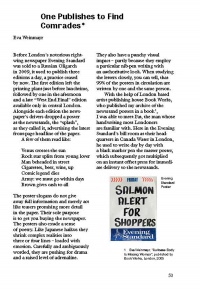
'One publishes to find comrades', chapterThe text investigates feminist practices of publishing as a way to initiate a social process or build a social space wherein meaning is generated via the co-created publications. The text discusses publishing practices, where printed publications, posters or zines are not necessarily an end product trying to convince someone of something, but rather a method of 'working towards establishing conditions for the co-production of meaning'.[4] in Publishing Manifestos, Michalis Pichler(ed.), Cambridge MA: The MIT Press, 2018. |
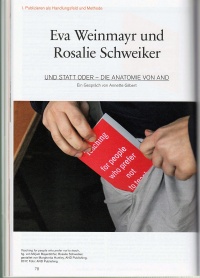
'UND STATT ODER – die Anatomie von UND' (AND not OR, the Anatomy of AND, interview)Annette Gilbert in conversation with Rosalie Schweiker and Eva Weinmayr (AND Publishing, London) about AND's collective feminist practice. The interview, itself being published in an anthology about contemporary artists' publishing, is an interesting case of intellectual streamlining and simplification of a messy and multilayered practice. The crucial point is here to draw the fine line between promotion or advertising and the "telling about" in Publish! Publizieren als künstlerische Praxis, Kunstforum International, issue 256, September 2018. |
Published presentation: 'Radical publishing practices ask for radical librarianship'
at Artists as Publishers as Artists, KHM University of Media Arts Cologne, 6 July 2018.
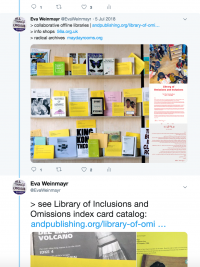
This presentation at the panel "Publishing to Mobilize Knowledge" takes an experimental approach to conference presentation. Using a twitter thread to publish the script in real time in order to share my bibliography, such as references, links to images, websites and texts for the audience to revisit – the presentation explores the infrastructures and politics of radical, collaborative, intersectional feminist publishing and its dissemination. With the participation of Clara Balaguer, Eva Weinmayr, Francesca Valentini, Gijs de Heij, Heike Ander, Lanfranco Aceti, Tamara Lorenz, (Tim), Tom Lingnau, and Yvette Mutumba. Organised by Agustina Andreoletti, Lilian Haberer, Karin Lingnau, Konstantin Butz. Supported by Birgit Trogemann. See programme Read the presentation
Library of Inclusions and Omissions
(2016–ongoing)
The Library of Inclusions and Omissions (LIO) is a practice-based experiment to set up a reference library that is curated by the community using it. So far roughly 100 contributions are on shelf. The collection is available to the public via temporary reading rooms. The library gathers feminist, intersectional, postcolonial materials which are not, or only sparsely available in institutional collections or databases, too flimsy in format or otherwise not validated by publishing houses or institutions such as libraries. Can such a curatorial concept help to give voice to undiscovered, suppressed or otherwise not acknowledged material? Can this turn a library from a repository of knowledge into a space of social and intellectual encounter?
Library of Omissions and Inclusions: The open call
Download Open Call English Swedish, Arabic
In order to receive contributions from a range of different cultural backgrounds and communities, the open call was published in Swedish, English and Arabic and distributed in community centres, libraries, universities, art spaces in and around Gothenburg (including suburbs such as Angered).
Library of Omissions and Inclusions: The index card catalogue
The practice of this library challenges the concept of neutrality and universality in standard cataloguing systems. Instead of using the 'controlled vocabulary' and classifications of institutional libraries, the LIO asks contributors for a short written rationale, why this book is important to them and why they want to share it with others. Through this the emphasis shifts from trying to frame the actual content of the book in an arguably objective manner towards describing the readers' personal making of meaning and the publications agency for the reader. The short statements are printed on the LIO´s index cards thus serving as an entry point and framing device for the library users. This subjective catalogue approach can be understood as an experiment to connect people through their readings, discoveries, desires, struggles and hopes.
Library of Omissions and Inclusions: Temporary Reading Rooms installed in different contexts.
-
- The platform 'Meaning Making Meaning' was a three-part project convened by Gabo Camnitzer and consisted of an exhibition, a series of workshops and the LOI´s reading room. In the exhibition and related workshops, 37 artists and educators responded to two questions: “How do you bring a classroom to life as if it were a work of art?” (Felix Guattari, Chaosmosis) and its reformulation: “How do you bring a work of art to life as if it were a classroom?” [5]
- Reading room at 'The Research Show', A-venue Gothenburg, April 2016
- 'The Research Show' was an informal work in progress exhibition from doctoral researchers based in the artistic faculty of the University of Gothenburg, where it was convened by Cora Hillebrand, Ram Krishna Ranjan, and Mick Wilson.[6]
- Reading room at 'Let’s Mobilize: What is Feminist Pedagogy?', Valand Academy, 12-14 Oct 2016
- The Library of Omissions and Inclusions was installed during the three-day international mobilisation dealing with queer and feminist pedagogies. Participants of the event came from seven European countries. They were asked to bring material to add to the library. 'Let's Mobilize: What is Feminist Pedagogy?' was organised by the Feminist Pedagogy working group at Valand Academy. [7] (see detailed project description below).
- Reading room at 'Utopia of Access', Pavilion for Artistic Research, Venice Biennale, 11 May - 2 July 2017
- Curators Jan Kaila (Uniarts Helsinki) and Henk Slager (Utrecht University) invited ten researchers from different Nordic doctoral programs to articulate new modes of artistic thinking regarding the notion of access. My approach to install a reading room in Venice was led by questions such as: Can a collectively owned resource be exhibited at an international art show such as the Venice Biennale? What are the underlying politics of 'exhibiting' a collectively owned resource, based in a local community in Sweden, in the context of such a worldwide show? Can I exhibit 1:1 scale photographic representation of the books on the shelves? How can I 'tell' about this practice? Can I exhibit its method as a proposal to create and sustain a non-normative knowledge commons? I presented a 1:1 scale photographic representation of the books on their shelves accompanied by a printed pamphlet discussing the politics of exhibition making as an act of taking rooted things out of original contexts and as a step of artistic co-option. (see text 'Dear Hannah')
- Reading Room at AND Publishing Research Residency – 'Boxing and Unboxing', Marabouparken Konsthall, 21 April – 26 August 2018
- A similar analysis was applied when selected publications from the Library of Omissions and Inclusion were installed at MarabouParken Konsthall in Stockholm in summer 2018. Playing with the pun 'Boxing and Unboxing', we planned to display cardboard boxes, shipped from London to Stockholm, containing materials we were working on at the time and to invite visitors to 'unbox' its contents,[8] In order to escape the limiting exhibition framing and to create a more conducive environment for this intended process of discovery, we decided to move out of the designated exhibition hall and to go 'backstage'. We negotiated with the institution to take over a spare room between the kitchen and the administrative offices on the first floor of MarabouParken Konsthall. The spatial proximity of the artists' Unboxing Room to the usually not accessible admin offices allowed us and the visitors to work in daylight and it made the else hidden work taking place in the offices visible to visitors.
Published text: 'Dear Hannah'. On the occasion of 'Utopia of Access', Pavilion of Artistic Research, Venice Biennale 2017
The text reflects on issues of co-option and the dilemma of 'exhibiting' a collective resource, which is based in a local community, within the context of an international art biennale. It is written in epistolary form addressing an undisclosed peer artist named Hannah. It has been published via email using my professional and personal email lists and was also available as printed pamphlet and element of my work in the exhibition 'Utopia of Access', Venice Biennale 2017.
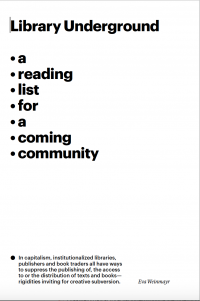
Published chapter 'Library Underground – a reading list for a coming community, in "Publishing as Artistic Practice", edited Annette Gilbert, Berlin/New York: Sternberg, 2016
This chapter, written in the form of a dialogue between Eva Weinmayr and her inner voice, discusses modes of knowledge dissemination. The text reflects on libraries as spaces where private knowledge is turned into public goods. It discusses the radical librarian movements of the 70s and 80s and deals with the topic from three fundamental angles: (i) who is a library for (the status quo at the time was a male, white, western and middle-class user community), (ii) what material is missing in libraries in order to "serve every member of the community"(American Library Bill of Rights, 1930x) and (iii) what implicit biases in the organisation and classification of knowledge can be found in libraries (Berman 1985x). The text also discusses a range of contemporary practices of radical librarianship - such as aaaaarg.fail, memoryofthe world, the Piracy Project - as well as practices which respond to the problems of marketisation and monopolisation of knowledge. Download chapter
Performative reading of chapter 'Library Underground' at 'Miss Read', Akademie der Künste Berlin, 2016
Miss Read Artist Book Festival and conference, organised by Michalis Pichler, Yaiza Camps, Moritz Grünke. The panel 'Publishing as Artistic Practice' was convened by Annette Gilbert. The performative reading of a revised and updated script of the original text 'Library Underground' was performed by Eva Weinmayr as Eva Weinmayr and Eleanor Vonne Brown as Inner Voice.
Filmed performative reading of chapter 'Library Underground- welcome to my tent' at symposium 'Photography in Print and Circulation', Valand Academy Gothenburg, 2016
Convened by Louise Wolthers (Hasselblad Foundation) and Niclas Östlind (Valand Academy).
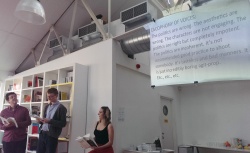
The text has been performed from inside a trekking tent installed on the stage of Valand's main lecture hall with a video camera transmitting what happens inside the tent onto the lecture hall screen. With Eva Weinmayr as Eva Weinmayr and Rose Borthwick as Inner Voice. Filmed and edited by Camilla Topuntoli. Video 32 min. Library Underground - watch video
Alternative cataloguing workshop: 'Reading Gendered Words' at Symposium "Library Interventions", Leeds College of Art, April 2017 with Rosalie Schweiker
The workshop was convened by Rosa Nussbaum and included a conversation between Maria Fusco and Wendy Kirk (Glasgow Women Library) around cataloguing practices at the Glasgow Women Library. Its aim was to develop unorthodox approaches to cataloguing selected titles from the Library of Omissions and Inclusions in order to experiment with alternatives to the normative “controlled vocabulary” used in the standardised library classification systems.
-
 Video recording of 'Welcome to my ten', a performed reading of a revised version of the conversation between Eva Weinmayr and her Inner Voice, based on the published text 'Library Underground-a reading list for a coming community', Sternberg Press, 2016. With Eva Weinmayr as Eva Weinmayr and Rose Borthwick as Inner Voice. Filmed and edited by Camilla Topuntoli. Video 32 min, 2016

The Piracy Project – with Andrea Francke and multiple collaborators (2010–ongoing)
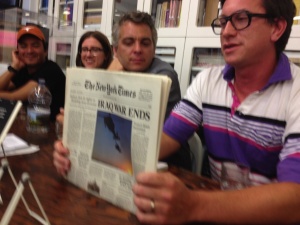
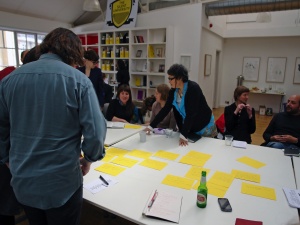
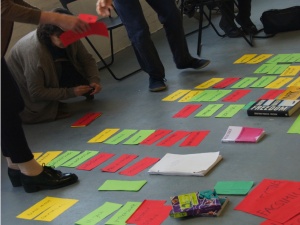
I began The Piracy Project in 2010 together with artist Andrea Francke. Through an open call for pirated books and by researching pirate book markets in Peru, China and Turkey, The Piracy Project gathered a collection of around 150 copied, emulated, appropriated and modified books from across the world. Their copying approaches vary widely, from playful strategies of reproduction, modification and reinterpretation of existing works to circumventing enclosures such as censorship or market monopolies, to acts of piracy generated by commercial interests. This collection of books serves as the starting point to explore the common understanding of authorship, originality and the implications policy and legal developments have had on intellectual property and copyright. Through temporary reading rooms, workshops, lectures, discussions and debates The Piracy Project explores the philosophical, legal and social implications of cultural piracy and creative modes of dissemination.
| Visit searchable online catalogue |
| See full list of Piracy Project discursive events and reading rooms organised between 2010 – 2015 |
|



Forthcoming chapter 'The Piracy Project', in “Archives of the Commons II - the Anomic Archive”, Red Conceptualismos del Sur, Museo Nacional Reina Sofia Madrid, 2018
The chapter is a revised manuscript of my presentation in the seminar "Socialising Archives" hold during the symposium "Archives of the Commons II" at Reina Sofia in Madrid, which was chaired by Mabel Tapia. I took this invitation and its distinct question to share experiences and methods, the operational strategies to turn the archive into a space of social and intellectual encounter as opportunity to reflect the curatorial and operational strategies we employed while working on The Piracy Project. [Read here the draft version ]
Forthcoming chapter 'Confronting Authorship, Constructing Practices' in “Whose Book is it anyway - an anthology”, Cambridge: Open Book Publishers, 2019
The anthology is edited by Sarah Kember and Janis Jeffries, Goldsmiths University London, and CREATe (RCUK Centre for Copyright and New Business Models in the Creative Economy, University of Glasgow). I took this text as an opportunity to investigate the relationship between authorship and copyright, as it is presented to us from a legal, economic and institutional perspective. I do this by three means: I investigate through literary review how artists have arguably challenged the close ties between authorship and copyright looking at cases, such as Richard Prince and Cady Noland. Secondly I reflect how the question of authorship plays out in the collective practice 'The Piracy Project'. Thirdly I turn this essay itself into a practice-based experiment by asking how it would live and circulate and be validated in institutional research economies, if I didn't assign my name and therefore authorship to the text.
Published interview 'The Piracy Project' at 'Giving What you don’t have', 2013
Cornelia Sollfrank interviews Andrea Francke and Eva Weinmayr in the context of 'Giving What you don’t have', an artistic research project by Cornelia Sollfrank exploring the relationship between art and the commons at Postdigital Publishing Lab, Leuphana University, Lüneburg Watch the interview or read the transcript
Transcript of interview 'The Piracy Project' – Abigail de Kossnik (Berkeley Media studies) interviews Andrea Francke and Eva Weinmayr, 2016
Published text 'The Impermanent Book', co-authored with Andrea Francke, Rhizome, 2012
The text was included as print edition in 'Best of Rhizome 2012' edited by Joanne McNeil, Brescia: LINK Editions, 2013 The text looks at the desire of dealing with a stable book, an permanent object, which is resolved and fixed in print. It argues, that it is the technical advances of the analogue printing press combined with mass production that constructs the contemporary idea of books as fixed objects. A concept where immutability is a key factor that allows for mass and consistent reproduction. What are the consequences for the book as the authoritative object, to which one can always come back to, when digital technology facilitates mass production and mutability at the same time? Digital print and print-on demand have become widespread and allow for continuous changes, adaptions and revisions. The text discusses the assumed unease and fundamental challenge this kind of versioning exerts on the reader. What happens when books become unreliable objects, when one copy of the book potentially tells a different story than the other? Read text on Rhizome.org
- File:Eva Weinmayr Confronting Authorship, Constructing Practices.pngForthcoming chapter 'Confronting Authorship, Constructing Practices', in Whose Book is it anyway - an anthology, Sarah Kember, Janis Jeffries (eds.), Cambridge, Open Book Publishers, 2019


Let's Mobilize: What is Feminist Pedagogy? three-day mobilization and workbook – with Feminist Pedagogy working group at Valand Academy, University of Gothenburg (2015–2016)
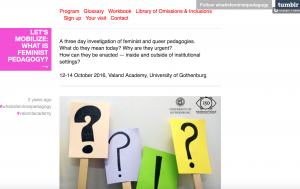
'Let's Mobilize: What is Feminist Pedagogy?' is a long-term investigation into queer and feminist pedagogies, that led to the collective organising of a three-day international mobilisation at Valand Academy in October 2016. The Feminist pedagogies working group consisted of students and staff at the academy (names). Its aim was twofold: Firstly the bi-weekly gatherings which were open to the whole academy provided a space to reflect on our own learning and teaching experiences, to read together and discuss relevant texts as well as to share infos and news, which were not officially communicated. The second and related aim was to organise an international conference, which developed alternatives to the dominant norms of conference organisation by fundamentally rethinking the terms and conditions of how knowledge is created and disseminated. Accompanying the event, a workbook was published, which tested the agency of publishing in terms of rethinking the processes of production and distribution.
Working group 2015-2016
How we worked. Why it was created. The shared readings. The format of the meetings...
Glossary: Mapping the concepts and ways of working for Let's Mobilize'
This glossary written by the Feminist Pedagogy working group and published in the workbook (see below), maps the ways and concepts of working with 'Let's Mobilize'. This glossary is an attempt to challenge and shift ways of organising a coming together at the art academy and the language used to describe it. It describes the context of the mobilization, the meaning of Feminist Pedagogies for the working group, explains the term mobilization, describes the formats chosen for coming together, the roles of the participants, the hosting, mobilization kit, language and economy.
Published Workbook: 'Let's Mobilize What is Feminist Pedagogy?'
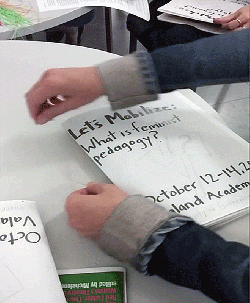
[more here] Rethinking the production and dissemination of a book. How to invite others in the conversation? Make your own copy: Collective collating and binding. The distribution. Hanging poster-pages in the academy and turning the academy in a walkable book. Contextual distribution. Has been used as course reading in courses at the academy. Is downloadable online. Circulates through indy bookshops.
The organising of the mobilisation - administrative creativity
The organising practices are analysed in more detail in chapter [6] analysis. However I would like to leave it as 'submitted material', because I argue that organising to be recognised as work.
Subsequent invitations to workshops and talks
The different experiences of 'telling about' includes
- a presentation at Exploiting Justice, Symposium, Centre for Interdisciplinary Gender Research, University of Gothenburg, 2016
- What is an Artschool, Cheslea College of Art, London, 2016
- 'Doing Together', a workshop with students at Cologne University, Institute of Art and Art History: Feminist Arts Education series, 2017
- [I think there were more... Andreas, MC, Rose ... you did something at HSM? Any other occasions?]
Forthcoming chapter 'Outside the Page' in issue "The Filmic Page", On Curating ZHdK Zürich
This chapter discusses how the format of the publication determine its dissemination and related the modes of reading. The text contrasts Marcel Broodthaers' two-piece work 'Voyage on the North Sea' (1974) with the distribution of poster-size pages of 'Let's Mobilize: What is Feminist Pedagogy Workbook' across the building of Valand Academy. [more and better description needed...]
Forthcoming chapter 'Let's Mobilize Revisited' (working title) in "Decolonialism after the educational turn"
The working group took the invitation to contribute a chapter to this book as an opportunity to revisit the collectively authored "glossary" in the 'Let's Mobilize workbook' in which we explained the reasons and the aims for the mobilisation. This act of revisiting the original text allowed us to reflect with hindsight on our working together. By using the method of layered commenting, we preserved each authors voice instead of streamlining the writing into observations and statements each member could agree with. Here the collective writing of a text becomes a place for dialogue and disagreements. It builds on experiments of non linear writing done by Arno Schmidt ('Zettel's Dream', 1970) and Pierre Bayle ('Historical and Critical Dictionary', 1737).
- File:Let's Mobilize poster pages at Valand Academy.jpg'Let's Mobilize' workbook pages enlarged to A0 posters distributed across Valand Academy



Unboxing, AND Research Residency, MarabouParken Konsthall, Stockholm
(April – August 2018) with Rosalie Schweiker
During the five-months research residency at MarabouParken in Stockholm AND Publishing organised together with curator Jenny Richards boxing training for self-defining women, installed an "Unboxing Room" with the boxes of materials they brought from their UK based practice and held three public talks.
MarabouParken Konsthall's evolving strand of research residencies aims to collaborate with artists groups and collectives in order to support their practice by developing "new lines of inquiry over a 3 month period and share these with a public through workshop and events.[9] The overarching strand called "Acts of Self-ruin" was based on Leela Ghandi's book "The Common Cause" inviting collectives to explore the struggle for collectivity and equality in an age of individualism. .[10]
Terms and Conditions of working with institution
In order to reach clarity about the mutual expectations concerning the five months research residency AND, together with Marabouparken curator Jenny Richards, developed a document titled 'terms and conditions' and a related contract between the artists and the institution. That document was regularly revised and adapted over the course of the residency. Selected points discussed in this document referred to "visibility on our own terms" (images, announcements, framing), public engagement, transparent budget.
Set of posters
A set of four posters were printed and circulated in the imminent neighbourhood and across Stockholm. Translated into Swedish, English, Arabic and Tigrinya (the two biggest ethnic groups in the area of the Konsthall), they announced two weeks of boxing training for women, girls, trans and non-binary people in order to learn more about non-verbal negotiation, care, anger, dialogue, transgressions and defence. The boxing classes were free and open for all abilities, ages (16+), shapes and religions and were an experiment to learn to relate to each other and to negotiate the many conflicts and contradictions which shape our living and working together.
Boxing classes
For the boxing classes Stockholm based boxers Sofia Thorne and Airin Fardipour have been invited to develop a two week intense course for beginners. The boxing classes took place at 'Project Playground', an after school club for immigrants in Hallonbergen. The course taught lets of technique, the basic moves and punches, as well as extensive sparring and body contact work and finished with a one-round fight competition.
'Unboxing Calendar', published by AND Publishing London / MarabouParken Konsthall, Stockholm, 2018
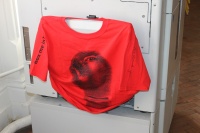
A calendar with 52 weekly pages containing collectively with the boxers' produced visuals. The collages result from a one-day workshop, where we tried to revisit the spirit and adventures during the boxing classes and to articulate visually the experiences, that could not easily be verbalised. The visuals in the calendar are accompanied by a text written by Ar Parmacek, at the time intern at MarabouParken Konsthall, which reflects some of the concerns of the project from her perspective of an co-organiser and observant. Choosing the form of a calendar as publication genre aims to embed its issues and contents into everyday life. A year of daily boxing and unboxing.


Topic Co-option
Published book 'Downing Street', New Documents, Los Angeles, 2015
The Downing St. or Help! David Cameron Likes My Art is a play script, using, as a starting point, a real circumstance: Eva Weinmayr’s work 'Today Questions' was borrowed from the UK Government Art Collection by David and Samantha Cameron for their private residence at Downing St. when they first moved in. Weinmayr’s attempt to contact The Prime Minister and his wife to discuss this was ignored, so she, in collaboration with writer John Moseley and journalist Titus Kroder, scripted the meeting that had been denied. The play imagines that the Camerons invite the Eva Weinmayr to visit them and while the artist Eva has tea with Samantha Cameron a rather unexpected set of events starts to unfold. The play acts as a catalyst for debate: The audience, which is scripted as a persona in the play, repeatedly interrupts the narrative in order to suggest a different strategy how to resolve Eva’s dilemma. The script has been premiered as Twitter broadcast, where each character tweeted their lines from the character's specially for this purpose set-up Twitter account (David Cameron, Samantha Cameron, Eva Weinmayr, Uzbek Ambassador,Horse Guard etc.) Subsequently it has been performed live in private and public venues, such as Edinburgh Festival, a pub, a friend’s living room, as well as a rehearsed performance at the Showroom in London directed by Hester Chillingworth of company GETBACKINTHEVAN. https://new-documents.org/books/downing-street
Published chapter: Help! David Cameron Likes my Art, in "Distributed", Open Editions 2018
edited David Blamey and Brad Haylock.
The text narrates the events and agonies brought about by the UK Government Art Collection’s acquisition of my art work ’Today’s Question’ and its subsequent loan to Samantha and David Cameron for their private residence at Downing Street, then Prime Minister of the UK. http://www.openeditions.com/index.php/distributed.html
chapter to be written: Eva Weinmayr/Heiner Müller, Keep it Complex/Wolfgang Tillmans
xxxx


Notes section [4] 'List of submitted material'
- ↑ Support included colleagues's offer to share office and equipment, including publishing classes in their courses inviting AND to develop publishing projects with students, facilitating work-based learning internships with AND. The management quickly realised the critical and socially generative potential of our activity and provided small funds and semi-official support
- ↑ AND was co-founded by Lynn Harris and Eva Weinmayr. Andrea Francke worked temporarily with AND. Today it is run by Rosalie Schweiker and Eva Weinmayr.
- ↑ OOMK, X Marks the Bökship, Keep it Complex in London
- ↑ Stevphen Shukaitis, 'Toward an Insurrection of the Published? Ten Thoughts on Ticks & Comrades', eicp transversal, June 2014 [1]
- ↑ It included work by Alina Tenser, Andrea Phillips, Ann-Charlotte Glasberg Blomqvist, Annette Krauss, Anton Vidokle, Barnfilmskolan, Bronwyn Bailey-Charteris, Cara Tolmie and Kimberley O’Neill, Doa Aly, Elizabeth Ellsworth and Jamie Kruse (Smudge Studio), Emanuel Almborg, Eva Weinmayr, Felicity Allen, Gert Biesta and Carl Anders Säfström, Glenn Loughran, Harrell Fletcher, Henry Giroux, Irit Rogoff, Janna Graham, Jaroslav Andel, Jason E. Bowman, Jenny Richards, Jessica Hamlin, Jeuno JE Kim and Ewa Einhorn, Katrin Ingelstedt, Lisa Nyberg, Lovisa Gustafsson, Maj Hasager, Maria Acaso and Jordi Ferreiro, Monica Sand, Olav Westphalen, Olivia Plender, Pedro Lasch, Stephan Dillemuth, Stephen Duncombe, Sunshine Socialist Cinema, and Tyson E. Lewis.
- ↑ Participating artists were André Alves, Eva la Cour, Kerstin Hamilton, Annelies Vaneycken, Arne Kjell Vikhagen, and Eva Weinmayr.
- ↑ The core working group's members were Andreas Engman, Eva Weinmayr, Gabo Cammnitzer, Kanchan Burathoki, Mary Coble, and Rose Borthwick.
- ↑ for example The Piracy Project, Teaching for people who prefer not to teach, The Library of Omissions and Inclusions, Let’s Mobilize: What is Feminist Pedagogy?, https://www.artsadmin.co.uk/events/3850 a selection of good and bad sports bras (D cup and upwards)], Keep It Complex, as well as our terms and conditions, emails and other miscellaneous items.
- ↑ Invitation email from curator Jenny Richards, 7 August 2017
- ↑ MarabouParken website


